

Do Google reviews help SEO? Yes, but I want to be precise about what that means.
Google reviews help most clearly with local SEO: your Google Business Profile, Google Maps visibility, the local pack, and the trust signals people use before they call, book, or ask for directions. They are not a magic switch that makes every website page rank higher. I have seen the best results when reviews are treated as one part of a complete local SEO system: accurate listings, strong categories, useful services, location pages, steady review requests, and fast review replies.
That nuance matters because most advice on Google reviews and SEO is too simple. “Get more reviews” is not wrong. It is just incomplete. The better question is this: are your reviews recent, specific, trusted, and tied to the locations you want to grow?

Manage Google reviews for all your locations from one dashboard. Centralize replies, automate with AI, and track review trends across every branch.
Start free trialDo Google reviews help SEO?
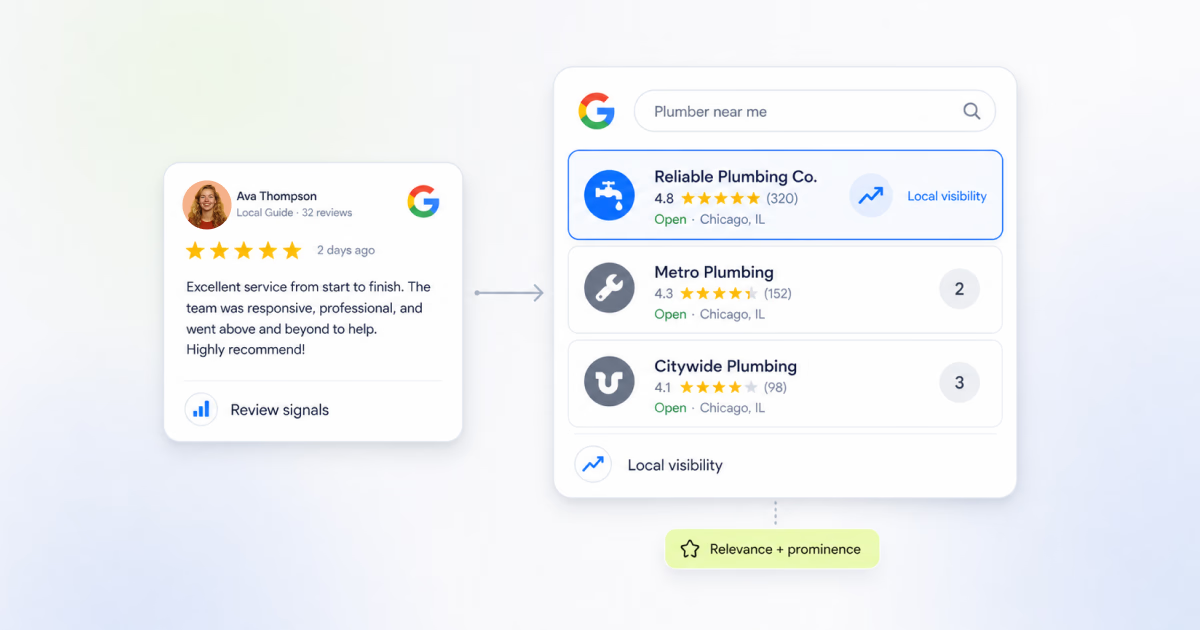
Yes. Google reviews can help SEO, especially local SEO. Google says local results are based on relevance, distance, and prominence. It also says more reviews and positive ratings can improve your business’s local ranking because they can strengthen prominence.
I would explain it this way to a business owner: reviews help Google and customers understand whether your business is active, trusted, and relevant. The review count, average rating, review recency, review text, and owner responses all add context around the business. That context can support visibility in Google Maps and the local pack. Curious what a higher average would take? Our free Google Review Calculator does the rating math for you.
But reviews do not replace the basics. If your categories are wrong, your address data is messy, or your website does not explain the services you offer, reviews alone will not save the profile.
How Google reviews affect local SEO
Google reviews affect local SEO because they influence the prominence side of local ranking. A business with frequent, detailed, positive reviews sends a stronger trust signal than a business with a thin or stale profile.
Reviews also affect user behavior. Searchers scan star ratings, read recent reviews, compare competitors, and decide whether to click, call, ask for directions, or keep scrolling. Those actions matter because local SEO is not just ranking. It is ranking and getting chosen.
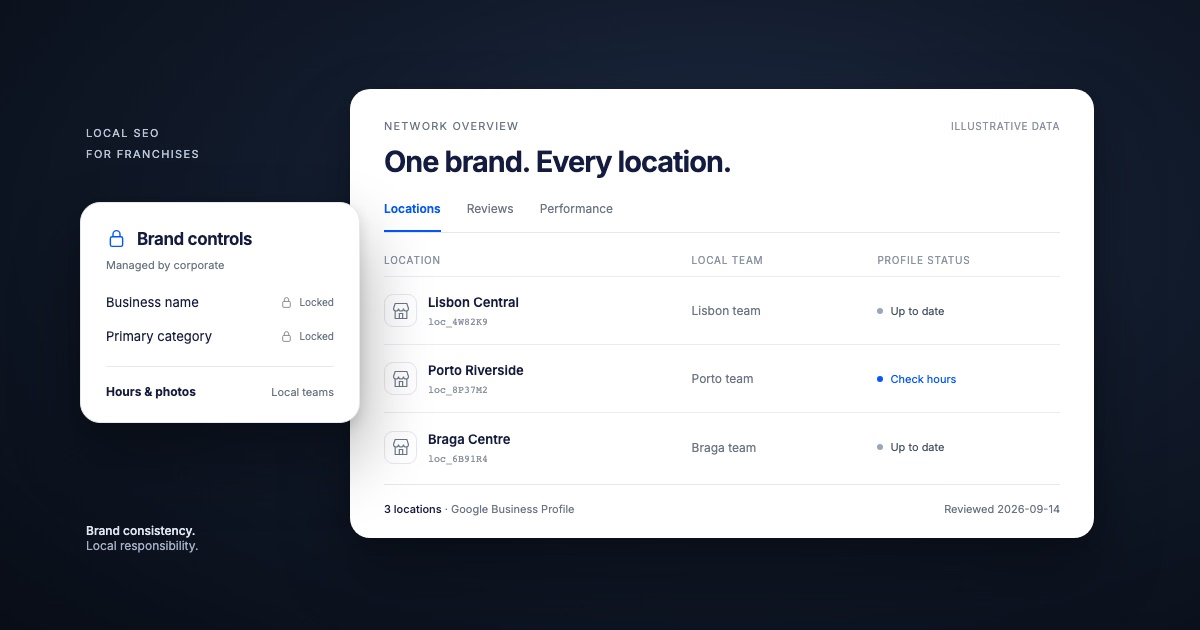
In local audits, I look for review gaps by location. If one branch has 400 reviews and another has 18, the weaker location usually has a harder time competing, even when the brand is the same. That is why multi-location review management matters. You cannot optimize reputation only at the brand level. You have to manage it location by location.
Do Google reviews help regular organic SEO?
Google reviews can support regular organic SEO indirectly, but they are not the same as title tags, internal links, content quality, or backlinks.
The organic SEO benefit usually comes through trust and conversion. Reviews can increase branded searches, improve click confidence, add proof to local landing pages, and help visitors choose you after they land on the website. If you reuse reviews on relevant pages, they can also support topical proof for a service or location.
Still, I would not tell a client that more Google reviews automatically push their blog posts or service pages higher. That is not how I would budget SEO effort. I would use reviews to strengthen the local search system and the conversion layer around the website.
Do review replies help SEO?
Review replies help SEO in a supporting way. They show that the business is active, responsive, and paying attention. Google also encourages businesses to respond to reviews, and customers often read owner replies before making a decision.
The best replies do three things:
- Thank the customer in a natural way.
- Mention the service or location only when it fits.
- Move sensitive or negative issues into a helpful offline path.
Do not stuff keywords into replies. A reply like “Thank you for choosing our emergency plumber Dallas drain cleaning pipe repair service” looks fake because it is fake. A better reply sounds like a real owner or manager wrote it: “Thanks for calling us for the emergency drain repair in Dallas. I am glad the team got it handled the same day.”
What Google actually says about reviews and local ranking
Google’s local ranking documentation names three core local ranking factors: relevance, distance, and prominence.
Relevance is how well your profile matches what someone searched for. Distance is how close your business is to the searcher or searched area. Prominence is how well-known and trusted the business appears to be across Google and the web.
Reviews sit inside that prominence layer. Google says review count and review score factor into local search ranking, and that more reviews and positive ratings can improve local ranking. That is the strongest official reason to take Google reviews seriously for SEO.
My advice is to use that statement carefully. It does not mean “any review tactic works.” It means a stronger, more trustworthy review profile can support local visibility. Fake reviews, review gating, employee reviews, and scripted keyword reviews can damage trust and may violate Google’s policies.
Google review SEO ranking factors that matter most
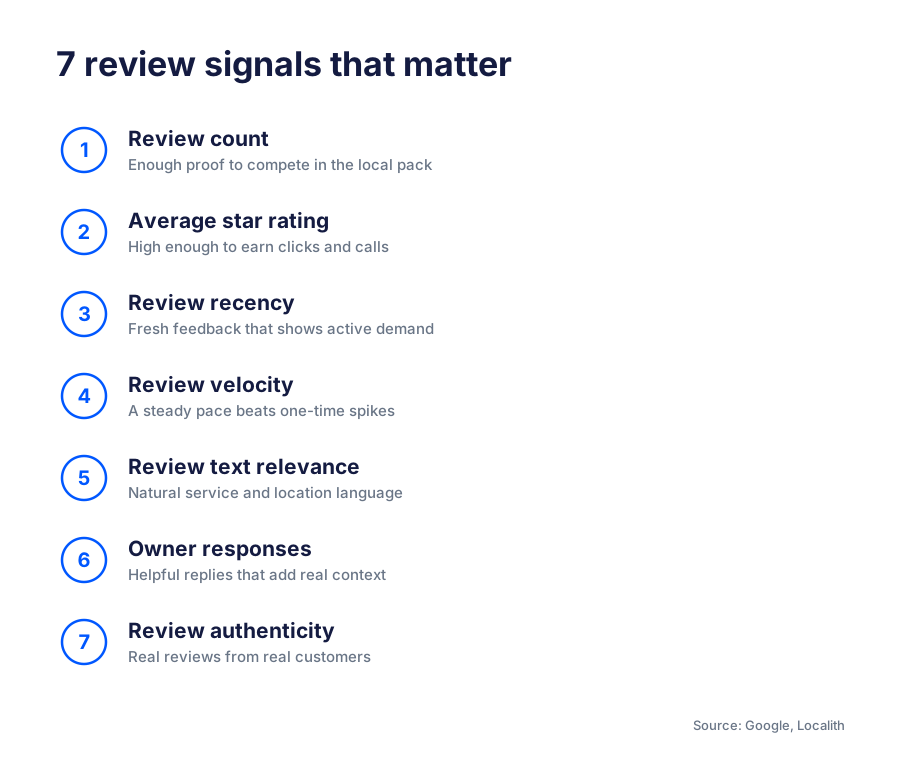
When I audit Google reviews for SEO, I focus on seven signals.
Review count
Review count matters because it gives searchers enough proof to compare you against competitors. A business with 12 reviews can rank, but it often has to work harder than a competitor with hundreds of real reviews.
The right number depends on the market. I compare each location against the top local competitors, not against a universal benchmark. If the top three competitors have 300 to 600 reviews, a location with 40 reviews has a visible trust gap.
Average star rating
Average rating affects clicks. A 4.7 profile usually feels safer than a 3.8 profile, even before the searcher reads a single review.
That said, perfect 5.0 profiles with very few reviews can look thin. A strong profile usually has a high rating, enough volume, and real review detail. The goal is not artificial perfection. The goal is credible trust.
Review recency
Recent reviews tell customers the business is active now. A profile with 200 reviews but no new reviews in a year can feel stale. A profile with a steady flow of recent reviews feels alive.
Review recency is one of the first things I check for multi-location brands because weak locations often do not have a review quality problem. They have a review habit problem.
Review velocity
Review velocity is the pace at which a business earns new reviews. Steady review velocity is healthier than sudden spikes followed by silence.
If a location gets 30 reviews in one week and then nothing for six months, that pattern looks less natural than a location getting a few reviews every week or month. Build the review request into the customer workflow so you do not rely on campaigns alone.
Review text relevance
The words customers use in reviews can help Google and searchers understand what the business is known for. Service names, product names, neighborhoods, and location references are useful when they appear naturally.
You should never script customer reviews. But you can ask better prompts, such as “What service did we help you with?” or “What stood out about your visit?” That gives customers room to be specific without pushing them into spammy wording.
Owner responses
Owner responses show operational care. They also let you add helpful context in your own words.
For example, if a customer mentions a vague “great experience,” your reply can naturally clarify the context: “I am glad our team made the oil change quick at the Northside location.” That is useful for humans first, and it supports local relevance without sounding forced.
Review authenticity
Authenticity is the line I do not cross. Do not buy reviews. Do not ask random people. Do not write “SEO-friendly” reviews for customers to paste. Reddit threads on local SEO keep circling back to this because business owners want shortcuts, but the risk is not worth it.
Real reviews from real customers are slower. They are also the only review strategy I would build a brand around.
How to optimize Google reviews for SEO
The goal is not to manipulate reviews. The goal is to build a repeatable system that earns real reviews, replies to them well, and turns review data into better local SEO decisions.
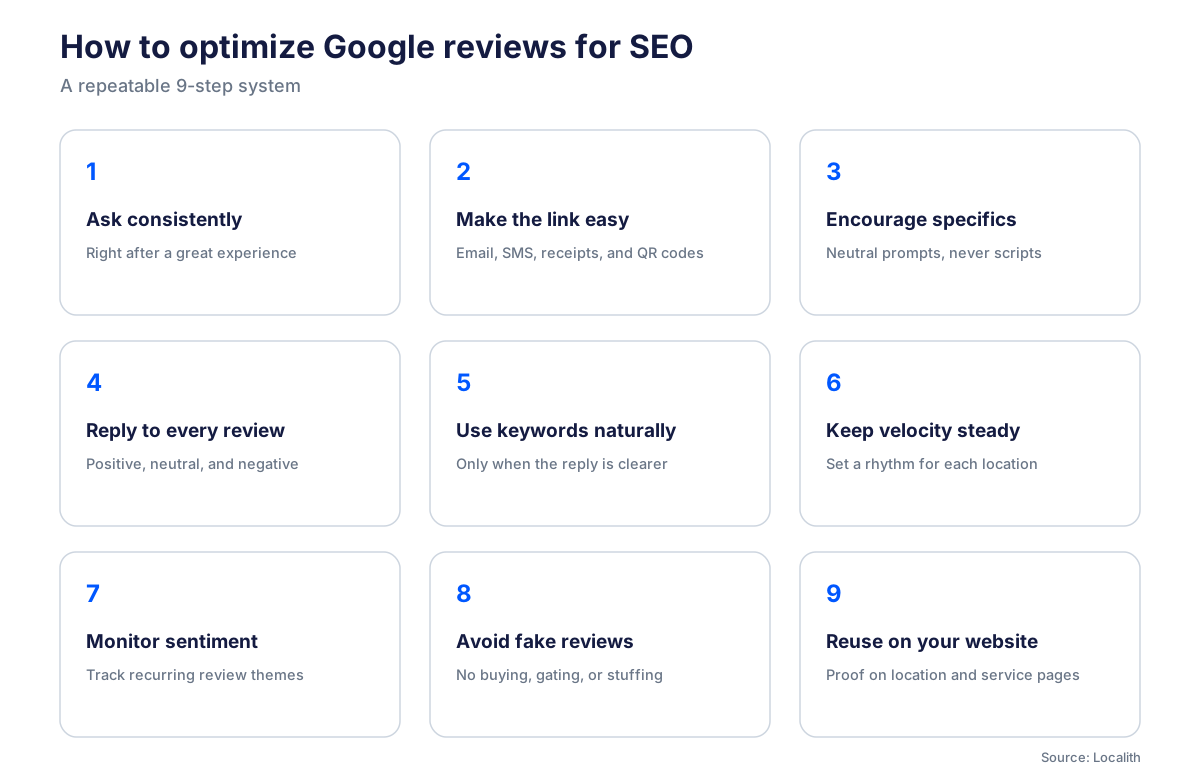
Ask for reviews consistently
The best time to ask is right after a successful customer interaction. That might be after a service visit, appointment, purchase, support resolution, or project handoff.
I prefer simple language:
“Thanks for choosing us. If everything went well, would you be willing to leave a quick Google review? It helps local customers find us.”
That works because it is honest. It does not pressure the customer, and it does not tell them what rating to leave.
Make it easy with a Google review link
Do not make customers hunt for your profile. Use a direct Google review link in follow-up emails, SMS messages, receipts, QR codes, and post-service workflows.
For in-person businesses, QR cards at the front desk or checkout area can work well. For service businesses, a follow-up text or email usually performs better because the customer can act while the experience is fresh.
Encourage specific, helpful feedback
Specific reviews are better for customers and better for local relevance.
Ask neutral prompts like:
- What service did we help you with?
- Which location did you visit?
- What made the experience useful?
- Would you recommend us to someone nearby?
Do not ask customers to use exact keywords. Do not hand them a script. If the prompt feels like SEO copy, it is already too much.
Reply to every review
Reply to positive, neutral, and negative reviews. The goal is to show that the business is present.
For positive reviews, keep the reply warm and specific. For negative reviews, stay calm, acknowledge the issue, and give the customer a path to resolve it. Do not argue in public. Future customers are reading your response as much as the original review.
Use relevant keywords naturally in replies
Keywords can appear in replies, but only when they make the reply clearer.
Good:
“Thanks for visiting our Midtown dental office. I am glad the team made your cleaning appointment comfortable.”
Bad:
“Thanks for choosing the best dentist Midtown emergency dental implants teeth whitening dental office.”
The first reply helps people. The second reply tells everyone you are trying too hard.
Keep review velocity steady
Set a review request rhythm for each location. If you manage many locations, do not let the strongest branches collect all the reviews while weaker branches go quiet.
I like to monitor monthly review growth by location and compare it with calls, direction requests, and local search visibility. If one location’s review velocity drops, that is a workflow issue to fix before it becomes a ranking and conversion problem.
Monitor review quality and sentiment
Review quantity is not enough. You need to know what customers are saying.
Track recurring themes: wait times, staff names, service quality, pricing, cleanliness, appointment availability, and location-specific issues. Reviews are not just an SEO asset. They are customer research sitting in public.
Avoid fake reviews, incentives, and keyword stuffing
Do not buy reviews. Do not review your own business. Do not ask employees to leave reviews. Do not offer rewards for positive reviews. Do not ask only happy customers while filtering unhappy customers away from Google.
I know shortcuts are tempting, especially when competitors look aggressive. But a review profile is a reputation asset. Once it looks fake, every future customer becomes harder to convince.
Reuse reviews on relevant website pages
You can use Google reviews on your website as proof. Add relevant reviews to location pages, service pages, and conversion sections where they help the visitor make a decision.
Keep the placement useful. A review about emergency plumbing belongs on an emergency plumbing page or the related location page. A general brand testimonial can support a homepage or about page. Match proof to intent.
When you want that proof to stay current, a Google reviews widget from EmbedSocial can pull live Google reviews onto those pages so visitors see recent feedback, not a static screenshot.
Use Localith to boost your Google reviews SEO benefits
This is where review SEO becomes operational. A single-location business can manage reviews manually for a while. A multi-location business cannot.
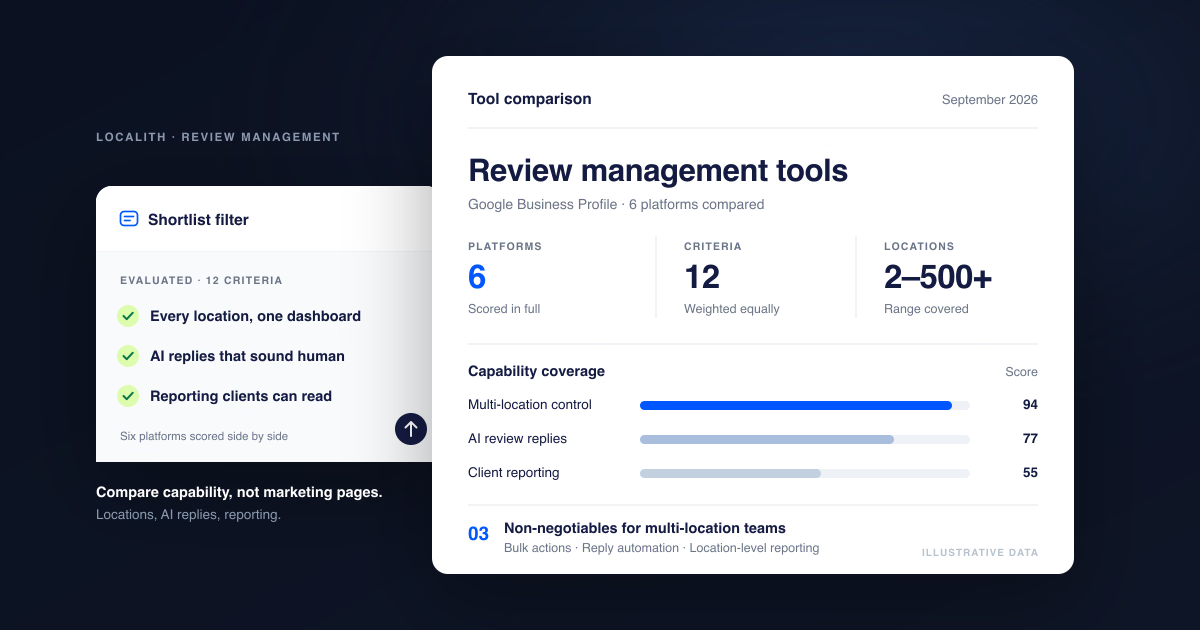
Localith helps you manage the review layer across every Google Business Profile from one place. You can monitor reviews by location, reply faster with the AI Review Reply Agent, find weak locations, compare review velocity, and keep responses consistent without making every reply sound identical.

How to measure the SEO impact of Google reviews
I measure review SEO impact with a mix of Google Business Profile performance, Google Search Console, and review growth data.
Inside Localith, use analytics for reviews and the review reporting section for GBP performance. Watch the metrics that connect reputation to local demand:
- Review count and review velocity by location
- Average rating by location
- Calls from Google Business Profile
- Direction requests
- Website clicks
- Maps and Search actions
- Branded searches
- Google Search Console query movement
- Landing page clicks and impressions

The goal is to connect review work to business outcomes. If reviews are improving but calls and direction requests are flat, you may have a conversion or listing issue. If calls rise after review velocity improves, you have a stronger case that review management is helping local performance.
Google review SEO workflow for multi-location businesses
For multi-location brands, I use a simple workflow.
First, centralize review monitoring so every location is visible. Second, set response rules so the team knows which reviews can be answered quickly and which need escalation. Third, compare review velocity and rating by location. Fourth, use the findings to fix weak locations.
With Localith review management, that workflow becomes easier to run:
- Monitor all Google reviews by location.
- Reply faster with AI-assisted drafts.
- Spot locations with low ratings or slow review growth.
- Compare review velocity across branches.
- Protect brand voice across every response.
- Report GBP performance to owners, franchisees, clients, or leadership.
The real benefit is control. You stop guessing which location is falling behind, and you start managing reviews as part of the local SEO system.
Conclusion: turn reviews into a local SEO advantage
Google reviews help SEO when they are part of a real local search system. They support prominence, improve trust, shape customer behavior, and give each location more proof in competitive local results.
The mistake is treating reviews like a one-time campaign. I would treat them like an operating habit. Ask consistently, reply well, measure the results, and use the data to find weak locations before competitors do.
If you manage multiple Google Business Profiles, Localith gives you the control layer for that work: review monitoring, AI-assisted replies, analytics, and GBP reporting in one place.
You can try Localith free and start with the locations that have the weakest review velocity. Fix those first, and the SEO benefits become much easier to see.

Turn Google Maps SEO into a repeatable workflow. Use Localith to audit profiles, track local heatmaps, prioritize weak locations, and keep every Google Business Profile moving.
Start free trial