

Local SEO for franchises breaks in places ordinary local SEO never does. The tactics are familiar: accurate listings, good categories, reviews, local landing pages.
What changes is who is allowed to do them. Corporate owns the brand, the franchisee owns the storefront, and rankings fail at the seam between the two.
A regional manager changes a primary category because it sounds better. A new franchisee creates a second Google Business Profile because they cannot get access to the first. A location moves two blocks and nobody updates the listing.
None of these are SEO mistakes in the usual sense. They are operational mistakes that produce SEO damage, and no amount of content fixes them.
This guide covers what actually moves the needle for a franchise network: how to divide ownership, how to fix the listing problems that quietly cost you rankings, how to handle reviews at scale, and how to measure per location instead of per brand.

Run every Google Business Profile from one operating dashboard. Localith centralizes listings, reviews, posts, and analytics so your team can manage every location without jumping profile to profile.
Start free trialWhat is local SEO for franchises?
Local SEO for franchises is the work of making every franchise location visible in local search, where the brand is shared but each location is a separate business with its own Google Business Profile, reviews, and service area.
The definition matters because it explains the hard part. Google does not rank your brand in local search. It ranks each location, in its own area, against its own competitors. A franchise with 80 locations is running 80 local SEO campaigns that happen to share a logo.
That is why network-level reporting is misleading. An average ranking across 80 locations tells you nothing about the twelve that are invisible.
How franchise SEO differs from multi-location SEO
Multi-location SEO assumes one company controls every location. Franchise SEO does not. Ownership is split, which adds a set of problems a corporate-owned chain never encounters:
- franchisees editing brand-level data like categories and business descriptions
- inconsistent contact information after a franchise changes hands
- duplicate profiles created by a new owner who did not know one existed
- disputes over which location owns a shared service area
- locations that go dark for weeks because nobody has access
The optimization tactics overlap almost entirely. The permission model is what makes franchise SEO harder.
Decide who owns what before you optimize anything
Most franchise SEO problems are access problems wearing a costume. Settle ownership first.
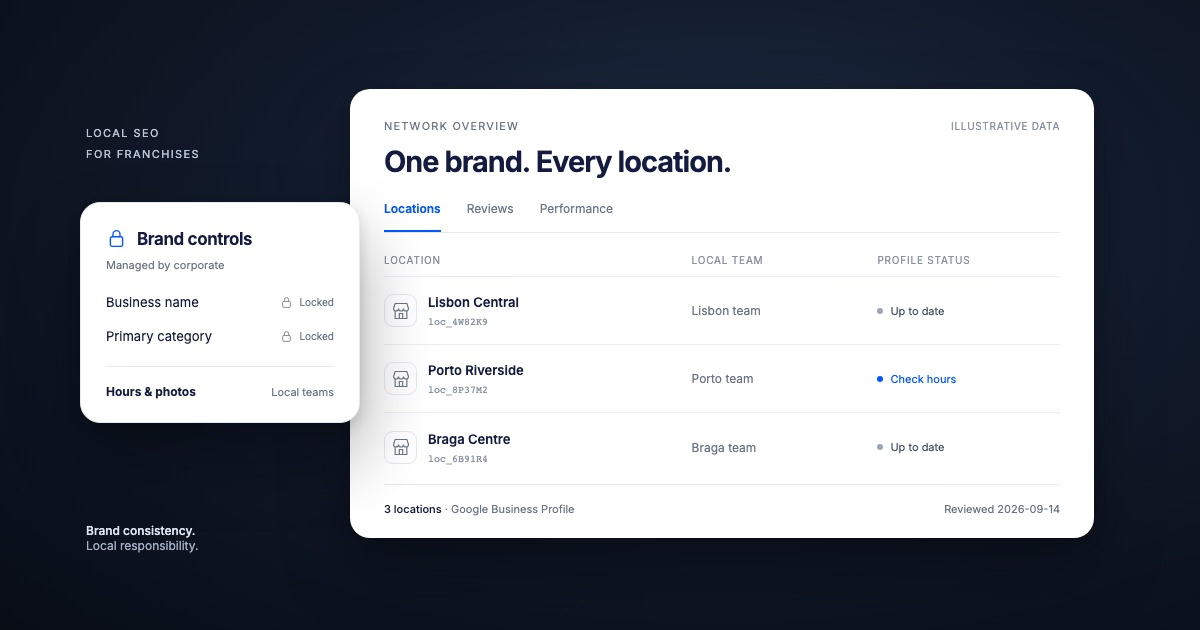
The pattern that works: corporate owns the profiles, franchisees hold limited access. Corporate keeps control of the things that affect the brand everywhere, and franchisees keep control of the things that change day to day in their store.
A workable split looks like this:
| Decision | Owner | Why |
|---|---|---|
| Business name formatting | Corporate | Inconsistent naming splits brand signals and risks suspension |
| Primary and secondary categories | Corporate | Category changes move rankings immediately |
| Business description | Corporate | Brand messaging and keyword strategy |
| Hours, holiday hours | Franchisee | Only the store knows |
| Photos | Franchisee, brand guidelines applied | Local photos outperform stock |
| Review replies | Shared, with approval on sensitive cases | Speed matters, tone risk is real |
| New location creation | Corporate | Prevents duplicates |
If franchisees own their profiles outright, the brand loses access the moment a franchisee leaves or sells. That is the single most expensive mistake in franchise local SEO, because recovering a profile from a former franchisee can take months.

Fix the listing problems first
Cleanup beats content for franchise networks, almost every time. These four problems are common, measurable, and fixable.
1. Duplicate profiles. Duplicates split reviews and ranking signals between two listings, so both underperform. They appear when a new owner creates a profile without knowing one exists, when a location moves, or when Google generates a listing from third-party data. Find them by searching the brand name plus each city, then resolve them rather than ignoring them.
2. Wrong or drifting categories. The primary category is one of the strongest local ranking factors, and it is also the field franchisees are most likely to change on instinct. Set the correct primary category once per location type, then lock it.
3. Unverified or dark locations. New openings that sit unverified for weeks are invisible during the exact period when local demand is highest. Treat verification as part of the opening checklist, not an SEO task for later.
4. Inconsistent core data. Name, address and phone details that disagree across locations and directories weaken the whole network. Standardize the format, then push it everywhere at once rather than editing profile by profile.
Doing this manually across a network is where it falls apart. A Google Business Profile dashboard that supports bulk updates turns a month of profile-by-profile editing into one action across the locations that need it.

Stop your own locations from competing
Franchise networks routinely lose rankings to themselves. Two locations in the same metro target the same city keyword, and Google splits the clicks between them or picks a competitor instead.
Three rules prevent most of it:
- Give each location a genuinely distinct service area. Overlap is inevitable in dense metros, but targeting should follow the actual catchment, not ambition.
- Do not duplicate location page content. Swapping the city name in an otherwise identical page gives Google no reason to rank either version. Local staff, local photos, local parking details and local landmarks are what make a location page worth ranking.
- Point each location page at one location. A single page listing twelve branches will not rank for any of their local queries.
Website structure: one domain beats a pile of microsites
Franchise networks tend to arrive at one of three website setups, and the choice has a large effect on how each location ranks.
Location pages on the brand domain. Every location gets its own page at brand.com/locations/city-name. This is the setup that works for most networks. Each location page inherits the brand domain’s authority, and the network builds one asset instead of many weak ones.
Franchisee microsites on separate domains. Each franchisee runs their own site on their own domain, and this is the weakest option for search. Every microsite starts from zero authority, brand signals scatter, and content quality varies with whoever the franchisee hired.
Networks usually adopt it because franchisees asked for independence, not because it performs.
Subdomains per location. A middle option that behaves closer to separate sites than most people expect. Workable, but rarely better than location pages on the main domain.
If you already run microsites, migrating is a large project and not always worth it. The practical compromise is to build proper location pages on the brand domain as the canonical destination, and point the Google Business Profile for each location there rather than at the microsite.
A location page earns its ranking with information only that location has: staff, parking, the nearest landmark, local service details, genuinely local photos, and the actual service area.
A template with the city name swapped in is not a location page, and Google treats it accordingly.
Keep citations consistent, then stop worrying about them
Citations, meaning your business details on directories and data aggregators, matter to franchises mostly as a consistency problem rather than a volume problem. Chasing hundreds of new directory listings is low-value work. Having three different phone numbers for the same location across the web is a real problem.
The franchise-specific risk is ownership turnover. When a location changes hands, the new franchisee updates Google and forgets the twenty other places the old details live.
Those stale records then feed back into Google’s understanding of the business.
Standardize the format once, apply it everywhere, and re-check after any ownership change, relocation or phone number change. Those three events cause nearly all citation drift in a franchise network.
Reviews are a per-location ranking signal
Review count, rating and recency all feed local ranking, and they are all per location. One flagship store with 900 reviews does nothing for the branch across town with nine.
At franchise scale the practical problems are response time and tone. Reviews arrive at every location, often in several languages, and the locations that need replies most are usually the ones with nobody assigned.
What works:
- One inbox for the whole network, so no location is invisible in the queue.
- Automatic drafting, so response time does not depend on headcount.
- Approval rules for anything sensitive, so a franchisee cannot publish something the brand would not say. Complaints, refunds, legal mentions and health or safety issues should route to corporate.
- Reporting per location and per region, so you can see response rate rather than assume it.
Localith’s AI review reply agent covers the first three: reviews from every location land in one inbox, replies are drafted in your brand voice, low-risk replies can publish automatically, and anything sensitive waits for approval.


Manage Google reviews for all your locations from one dashboard. Centralize replies, automate with AI, and track review trends across every branch.
Start free trialMeasure per location, never per network
The reporting mistake that hides everything: averaging.
A network average of “position 8” can contain twenty locations at position 3 and twelve that do not appear at all. The average moves slowly, so it looks stable while individual locations quietly fall out of the map pack.
Report on these, per location:
- search impressions and profile views
- calls, direction requests and website clicks
- review count, average rating and response rate
- local ranking visibility across the location’s actual area
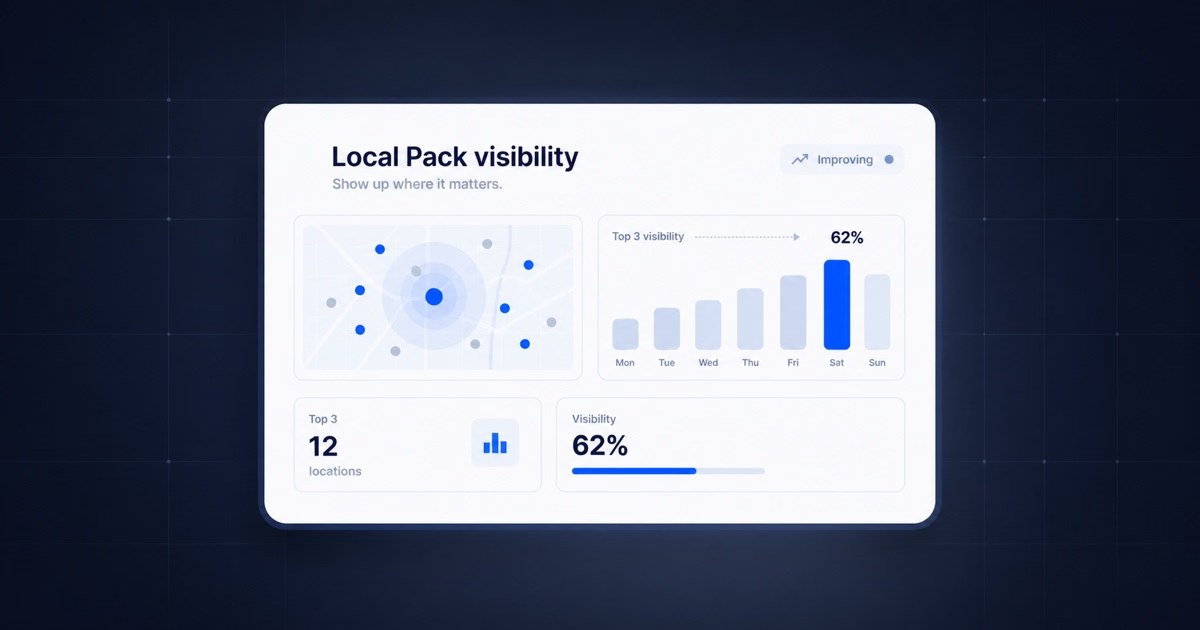
Rank heatmaps are the fastest diagnostic here, because they show where a location is visible in its own neighbourhood and where it disappears. A location that ranks well at its own address and vanishes three miles away usually has a profile problem, not a business problem.

For the reporting side of this, see our guide to local SEO reporting.
A franchise local SEO checklist
Work in this order. The early items are cheap and move fastest.
- Confirm corporate owns every profile, and audit who else has access
- Find and resolve duplicate listings across the network
- Standardize business name formatting everywhere
- Set and lock the correct primary category per location type
- Verify every unverified location, starting with new openings
- Push accurate hours, holiday hours and attributes in bulk
- Assign every location an owner for review replies
- Set approval rules for sensitive reviews
- Give each location page genuinely local content
- Switch reporting from network averages to per-location metrics
How Localith fits
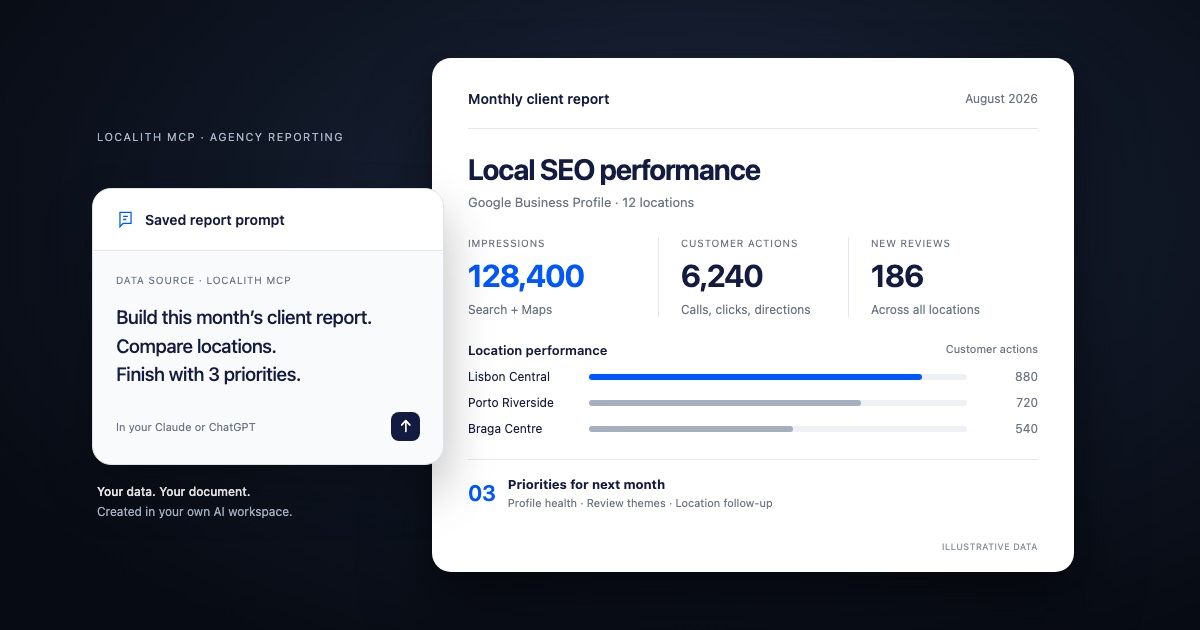
Localith is built for the operational half of this problem: keeping a network of profiles accurate, active and measurable without logging into each one.
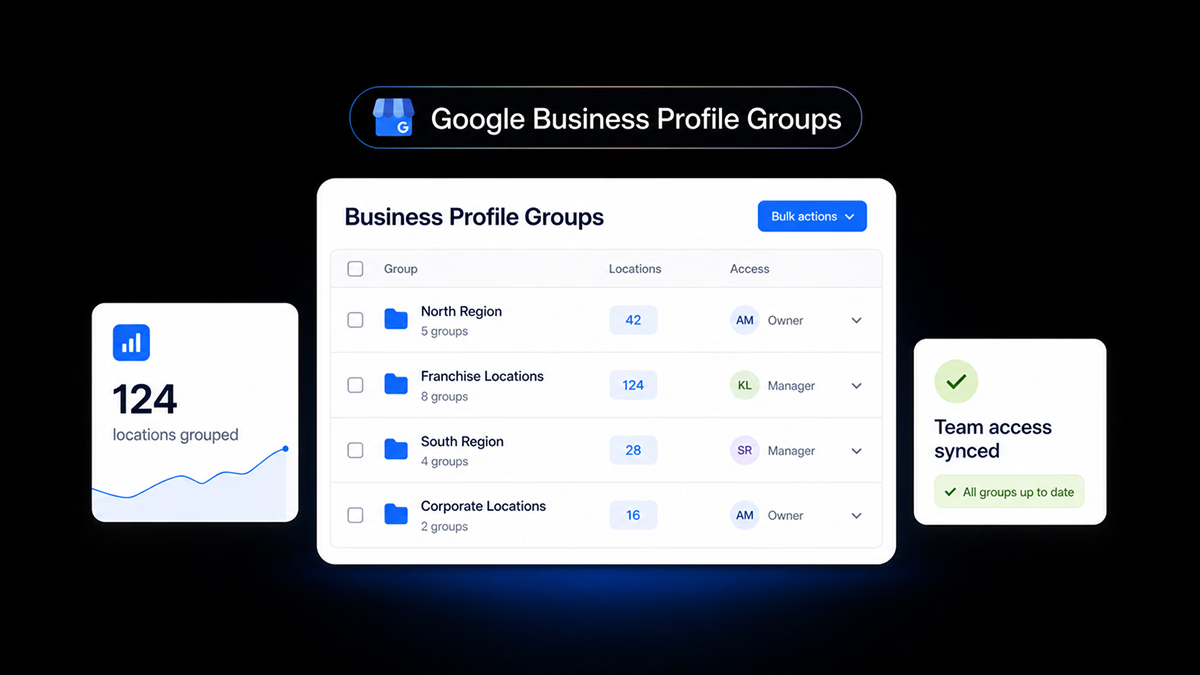
- Bulk updates push hours, categories, attributes and descriptions across the locations that need them in one action
- Approval rules let franchisees request changes while corporate keeps final say
- Profile locking blocks unwanted edits before they reach Google
- One review inbox with AI replies in your brand voice and routing for anything sensitive
- Rank heatmaps and per-location analytics so you can see which locations are actually visible
- Per-location and per-region exports for franchisee reviews
Pricing is per location and public: $9 per month covers 2 locations, and every location after that is $6.60 per month, so a 50-location network is $325.80 per month. There is no sales call required to start.
If you want the product view rather than the guide, see Localith for franchises.
Conclusion: fix operations, and the rankings follow
Franchise local SEO rewards housekeeping more than cleverness. The networks that win are not the ones with the best content strategy. They are the ones where every location is verified, correctly categorized, free of duplicates, actively replying to reviews, and measured individually.
Start with ownership and duplicates. Those two alone tend to surface more ranking recovery than a quarter of content work, and they are the only part of franchise SEO that gets harder the longer you leave it.
If you want to run that cleanup across the whole network rather than profile by profile, start a free trial and connect your locations.