---
title: "Google Local Pack: The Complete 2026 Ranking Guide"
date: "2026-08-27"
canonical_id: google-local-pack
author: "Localith Team"
category:
- local-seo
tags:
- "google-business-profile"
- "google-maps-seo"
- "local-seo"
- "multi-location"
summary: "Learn what the Google Local Pack is, how the 3-pack algorithm works, and what you can do to rank your business in it in 2026."
draft: false
template: "blog"
image: "blog/google-local-pack/google-local-pack-featured-v2.jpg"
faq:
-
question: "What is Google Local Pack coverage?"
answer: "Local Pack coverage refers to how often a Local Pack result appears for local-intent searches. For most local business categories, you can expect to see it on nearly every relevant search."
-
question: "What is the Google Local 3-pack?"
answer: "The Google Local 3-pack is the standard three-listing Local Pack format Google has used since 2015. It shows three local businesses with a map above the organic results for local searches."
-
question: "What are local packs?"
answer: "Local packs are blocks of local business results, typically three listings with a map, that Google surfaces for searches with local intent and ranks using proximity, prominence, and relevance."
-
question: "How is the Local Pack different from Google Maps results?"
answer: "The Local Pack appears directly inside Google Search results for local queries, while Google Maps is a separate interface that shows a larger set of matching results."
-
question: "What are the top Google Local Pack ranking factors?"
answer: "Google describes the main local ranking factors as relevance, distance, and prominence. Businesses can meaningfully influence relevance and prominence, while distance largely depends on the searcher's location."
-
question: "How long does it take to rank in the Local Pack after optimizing a profile?"
answer: "It varies by market competitiveness and your starting point. Consistent profile, review, and citation work may produce measurable movement within weeks or months, while highly competitive categories can take longer."
seo:
title: "Google Local Pack: What It Is & How to Rank in 2026"
description: "What is the Google Local Pack, how does the 3-pack algorithm work, and what actually gets your business ranked in it? Here's the 2026 playbook."
og_image: "blog/google-local-pack/google-local-pack-featured-v2.jpg"
structured_data: "article"
---
Three listings. A map. Above every organic blue link. That's the Google Local Pack, and it's the single highest-value piece of real estate in local search results.
If your business isn't in it for the searches that matter, you're effectively invisible at the exact moment someone nearby decides they need what you sell.
Therefore, I'll break down what the Local Pack actually is, how Google decides who gets into it, what you can concretely do about it, and how to tell if it's working.
I'll cover the mechanics first and then the checklist.
{{product-cta:local-seo-agent}}
## What is the Google Local Pack, and why is it called the "3-pack"?
> **The Google Local Pack**, also called the Map Pack or "3-pack," is the block of usually three local business listings, complete with a map, ratings, hours, and category, that Google shows above organic results for local-intent searches.
Search "restaurant near me" or "coffee shop downtown Austin," and the Local Pack is the first thing you see, before any website result.

**Quick fact:** Google used to show seven listings, the "7-pack." It moved to three in 2015, and the name "3-pack" stuck as industry shorthand.
**Where the listings actually come from:**
- Your Google Business Profile, not your website's on-page SEO.
- Profile accuracy and completeness come first. Website optimization comes second.
**Tip:** A beautifully optimized website attached to a thin, inconsistent profile still won't show up here. Therefore, you have to think about [optimizing your Google Business Profile](/blog/google-business-profile-optimization/) first.
**2026 update:** The Local Pack increasingly feeds Google's AI Overviews for local queries. Businesses ranking in the 3-pack are often among the options surfaced nearby, so the stakes go beyond three listings competing for clicks.
### Why "3-pack"? (and how it differs from the "Map Pack")
**"3-pack," "Local Pack," and "Map Pack" all refer to the same three-listing block.**
They're used interchangeably across the industry, so don't be thrown if you see all three in the same article, including this one.
The only distinction worth knowing is that "3-pack" emphasizes the *count* (three results), while "Map Pack" emphasizes the *format* (a map plus listings). Same feature, different angle of description.
## How Local Pack ranking actually works
Google describes local ranking using three factors: **relevance, distance, and prominence**.
The simplicity is deceptive. Most businesses that fail to rank aren't missing an exotic tactic. They're weak on one or two of these three basics.
| Ranking factor | What it means | How to improve it |
|---|---|---|
| Proximity (distance) | How close the searcher is to your business location at the moment they search. | This is largely outside your control, but an accurate, complete address on your Google Business Profile ensures Google reads your location correctly. |
| Prominence | How well-known and reputable your business is, based on signals such as reviews, links, articles, and directories. | Actively generate reviews, build local citations, and earn mentions from local publications and directories. |
| Relevance | How well your Business Profile matches what the searcher is actually looking for, based on your categories, description, and listed services. | Choose precise categories, write a description that mirrors how customers describe what you do, and keep services and attributes current. |
**Tip:** Diagnose which of the three is holding you back before working through a generic checklist. Guessing wastes effort.
### What doesn't count
There is no evidence that Google feeds these into Local Pack rank directly:
- Ad spend
- Website traffic volume
- Social media follower counts
They can support prominence indirectly. A well-known business naturally accumulates more reviews and citations. But chasing them directly, instead of the three factors above, is a common way local SEO budget gets wasted.
### Proximity: the one factor you can't touch
You can't move your business closer to every searcher. What you *can* do is make sure Google reads your location correctly with an accurate address and service area.
Profile accuracy and prominence pick up the slack proximity leaves behind.
### The three factors interact rather than work alone
A highly prominent business with strong reviews and real citations can outrank a closer competitor with a thin, unverified profile. Prominence and relevance can partially offset a proximity disadvantage.
**Why the checklist below focuses on two levers, not three:** proximity is mostly out of your hands. Prominence and relevance aren't.
### Domain authority doesn't decide this
A well-known, high-authority website doesn't automatically win here. Local Pack rank runs primarily through the Business Profile, not the domain.
**Tip:** A lower-authority local business with a complete profile and steady review velocity can outrank a bigger competitor whose profile is an afterthought. Don't assume site authority carries over.
## How the Local Pack displays, and how people actually use it
Once Google picks the top three, it packages each one for a fast decision, not a deep dive.
### What each listing shows
As you've seen above, every Local Pack entry typically includes:
- Business name
- Address
- Business hours
- Review rating
- An interactive map with location pins
### Built for one-tap interaction
Click the business name and you get the full listing, including call-to-action buttons for the website, reservations, directions, and calls, plus reviews, images, and social profiles.
**Tip:** This matters most on mobile. Searchers there want quick, actionable information. The Local Pack is built to deliver it in one tap, not a full site visit.

Want more than three options? Clicking **"More places"** expands into the full Local Finder list, an extension of Google Maps that opens from Search.

### The Local Pack updates constantly
Google re-evaluates placement continuously based on business information changes, user behavior, and new reviews.
If you're in it, staying in it takes upkeep:
- Keep business information accurate.
- [Respond to Google reviews](/blog/how-to-respond-to-google-reviews/).
- Keep optimizing your Google Business Profile.
**Tip:** Ranking factors don't stop mattering once you land in the pack. Relevance, proximity, and prominence keep deciding whether you stay.
## Local Pack vs. Local Finder vs. Google Maps
These three surfaces get conflated constantly, and the confusion can cause strategic mistakes, such as tracking the wrong search experience.
| | Local Pack | Local Finder | Google Maps |
|---|---|---|---|
| What triggers it | A local-intent search on Google Search. | Clicking "More places" from a Local Pack. | Searching directly within the Google Maps app or maps.google.com. |
| How many results show | Typically 3. | A larger, paginated result set. | Matching results in a scrollable Maps interface. |
| Where it appears | Embedded directly in Google Search results. | A dedicated results page opened from Search. | The separate Google Maps interface. |
The presentation also differs slightly by device. On mobile, the Local Pack tends to sit even more prominently above the fold, often visible before a searcher scrolls at all.
On desktop, it typically appears alongside a larger map panel. The ranking logic doesn't change between devices, but the amount of screen space (and therefore attention) the pack commands does.
If your business ranks in the Local Pack, it is visible in the Local Finder and Maps as well, but the reverse isn't necessarily true.
Plenty of businesses appear in the Local Finder's larger result set without cracking the 3-pack itself. That gap is exactly what this guide is built to address.
This distinction matters practically, too. If you're tracking "rankings" and only checking the Local Finder or Maps app, you may be seeing a rosier picture than what searchers encounter on the main results page. Treat the 3-pack as its own scoreboard.
## How to optimize your business for the Local Pack
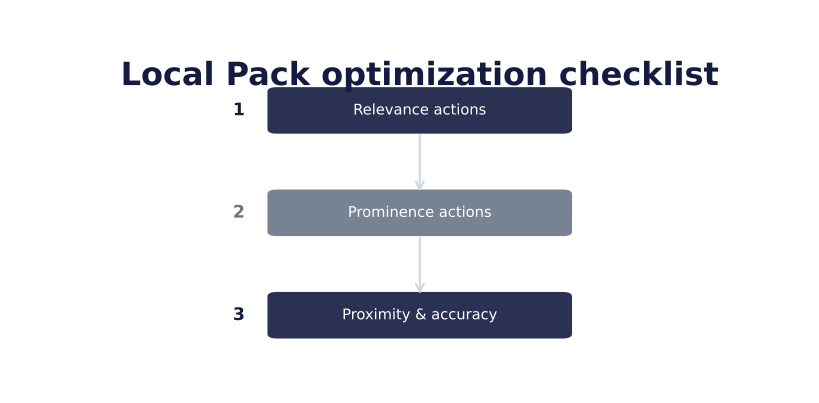
The checklist below is organized around the same three-factor framework (**relevance, prominence, and proximity or accuracy**), so each action maps directly to the factor it's meant to move.
Treat this as an ongoing system, not a one-time setup task.
A profile that was fully optimized a year ago and hasn't been touched since is quietly decaying on the prominence and accuracy fronts, even if nothing looks obviously wrong.
Meanwhile, competitors keep collecting reviews, hours change, staff turns over, and profile access gets lost. Businesses that hold Local Pack positions long-term treat this checklist as a recurring cadence, not a launch checklist to complete once and forget.
### Relevance actions
Start with the profile itself. Google can't rank you for what it doesn't understand you do, no matter how good your actual business is.
1. Complete your Google Business Profile fully. Categories, hours, services, and attributes all matter, and an incomplete profile is a self-inflicted relevance penalty. Pick the most specific primary category available, not the broadest one.
2. Weave local keywords naturally into your profile description and your website's on-page content, using the way real customers search rather than the way your business describes itself internally. A solid [local keyword research](/blog/how-to-do-local-keyword-research/) process makes this far less guesswork and surfaces phrasing you'd otherwise miss.
3. Keep photos current and high-quality. Stale or missing photos are a quiet relevance signal that Google and searchers both notice, and outdated exterior shots actively hurt trust when someone is deciding whether to visit.
### Prominence actions
Prominence is the factor most within your ongoing control, and the one that compounds over time rather than delivering a one-time bump.
1. Actively generate and respond to Google reviews. [Getting more Google reviews](/blog/how-to-get-google-reviews/) consistently is a habit, not a one-time push. A business with 40 recent reviews reads very differently from one with 40 reviews all from three years ago.
2. Build consistent local citations and backlinks. Use the same business name, address, and phone number everywhere your business is listed, from major directories down to niche local ones.
3. Post regularly and keep the profile active. A dormant profile gives potential customers fewer current signals than an actively maintained one, even if the underlying business hasn't changed.
### Proximity and accuracy actions
Proximity itself isn't something you can adjust, but how clearly Google reads your location is. That distinction is where many businesses waste effort chasing the wrong lever.
1. Keep your address and service-area data precise and consistent across every platform. Ambiguous or conflicting location data can make it harder for Google to understand where you actually are.
2. Audit your profile periodically to catch drift, such as categories that reverted, hours that fell out of sync, or details changed without you noticing. A structured [Google Business Profile audit](/blog/google-business-profile-audit/) catches this before it costs you rankings rather than after.
None of these three clusters work in isolation. Our [Google Business Profile management best practices](/blog/google-business-profile-management-best-practices/) guide is the fuller playbook for running all of it as a system rather than a one-time checklist.
## How to know if it's working: tracking your Local Pack rankings
So, how do you actually know if any of this moved the needle?
Local Pack rankings are volatile and hyper-local. Your position for the same keyword can differ block by block and even hour by hour as Google re-evaluates distance for different searchers.
That makes a single manual search from your office a poor way to judge progress. It tells you your rank for one specific point on the map at one specific moment, and nothing more.
You need to [track your Local Pack rankings](/blog/local-rank-tracker/) over time and across locations, not check once and assume the result holds everywhere.
This is where [Localith](/) comes in. The platform helps you manage your Google Business Profiles and track local rankings across your target area.

Localith will answer two important questions:
- Are you actually appearing in the pack for the keywords that matter?
- Is that position trending up or down as you make changes?
Without that visibility, you're left guessing whether last month's review push or citation cleanup did anything, or whether a competitor offset your gains.
Pair rank tracking with our [Google Business Profile dashboard](/blog/google-business-profile-dashboard/) so ranking data and profile health sit in one place instead of three tabs and two tools.
To be clear, no tool (Localith included) can guarantee Local Pack placement.
Local Pack rankings are Google's call, not any vendor's. Tracking gives you visibility into whether your optimization work is actually working, which is the difference between guessing and knowing.
## Conclusion: Treat the Local Pack as three checkable factors, not luck
The Local Pack isn't a lottery. It's shaped by relevance, distance, and prominence: three specific, checkable factors, not vague "SEO magic."
A focused profile, review, and citation strategy moves the two factors you can influence most.
Tracking whether that's working is just as important as doing the work in the first place.
Ready to see where your business actually stands in the Google Local Pack? [Localith's pricing](/pricing/) has a plan built for exactly this.
{{product-cta:gbp-dashboard}}